

Shopify Markets SEO: How to Expand Into New Countries Without Losing Rankings
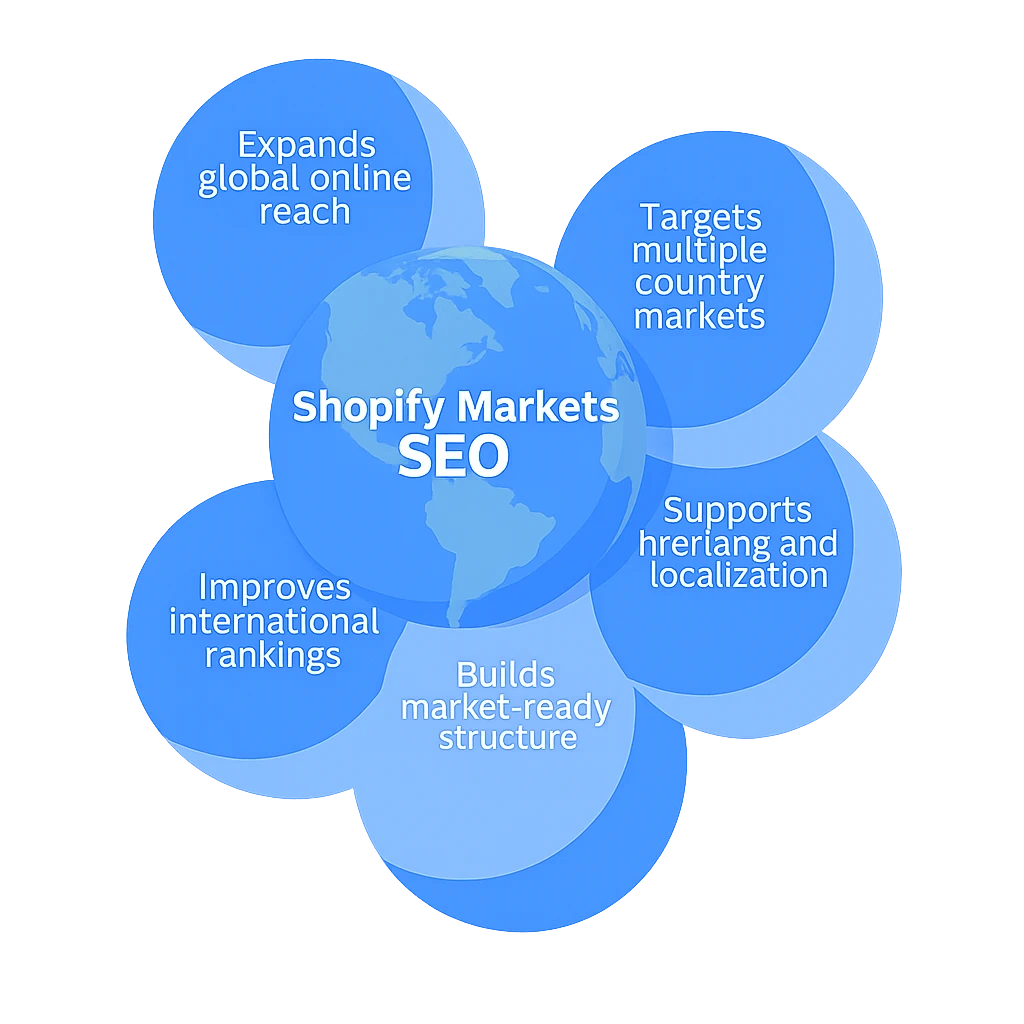
Expanding a Shopify store into new countries can unlock serious revenue, but it also creates SEO risk. The wrong structure, weak localization, or a messy hreflang setup can split ranking signals, confuse search engines, and slow down growth in a new market. For Shopify brands, international growth works best when SEO, localization, and market setup are planned together. That means choosing the right URL structure, configuring Shopify Markets correctly, and aligning language, currency, content, and search signals to each region before traffic starts moving. A strong Shopify Markets SEO strategy is not just about getting indexed in a new country. It is about building a market-ready store that can rank, convert, and scale without creating long-term technical debt.
Why international expansion needs a different SEO approach
Growing into new countries is not just a translation task. Every market introduces a different layer of complexity: search behavior changes, competitors change, pricing expectations change, shipping logic changes, and the way search engines interpret your store can change too. A proper international SEO setup helps your Shopify store:
- rank the right version of a page in the right country
- avoid duplicate content issues across markets
- preserve authority while launching new regional versions
- improve local relevance for both search and conversion
- support operational efficiency as the business grows
For Shopify merchants, the goal is simple: protect existing visibility while building new relevance in each target market. That takes more than translated copy. It takes a deliberate international structure and a clean Shopify Markets SEO setup.
Should you use one Shopify store or multiple stores for international growth?
This is one of the first decisions that matters. In many cases, one Shopify store with Shopify Markets is enough. It works well when the brand wants to manage multiple countries from one backend, keep operations lean, and use the same product catalog with localized pricing, domains, and languages. A single-store setup usually makes sense when:
- the product catalog is mostly the same across regions
- pricing and currency can be managed by market
- the brand wants simpler operations
- SEO authority should stay consolidated under one core domain structure
- teams want one store to manage content, products, and campaigns
A multiple-store setup can be better when:
- each market has a very different catalog
- legal requirements differ significantly
- regions need different fulfillment, ERP, or tax logic
- teams operate independently by country
- the business needs stronger separation between markets
The mistake many brands make is choosing multiple stores too early, or forcing everything into one store when the business model already requires separation. There is no universal answer. The right setup depends on catalog overlap, internal resources, localization depth, and long-term operational complexity.
Choose the right international URL structure
Your URL structure is one of the most important SEO decisions in any international rollout. In most cases, the choice comes down to subdirectories, subdomains, or ccTLDs.
Subdirectories
Subdirectories keep regional versions under one main domain, such as:
- example.com/uk/
- example.com/fr/
- example.com/de/
For many Shopify brands, this is the strongest balance of SEO value and operational simplicity. Authority stays more consolidated, management is easier, and internal linking remains cleaner.
Subdomains
Subdomains separate markets like:
- uk.example.com
- fr.example.com
This can work when teams or systems need more separation, but it usually adds complexity. Authority can become more fragmented, and technical management becomes less efficient.
ccTLDs
Country-code domains look like:
- example.co.uk
- example.fr
- example.de
These can improve local trust and brand perception in some markets, but they demand more resources. They often require more SEO work, more maintenance, and tighter governance. For most growing Shopify brands, subdirectories are the best starting point because they combine scalability, control, and search performance. If you are planning a rollout, it is smarter to validate the structure before launch than to fix fragmented organic visibility later.
How Shopify Markets SEO improves localization and user experience
Shopify Markets SEO is a critical part of international expansion because Shopify Markets centralizes country settings, domains, pricing, and localization workflows inside Shopify. When configured properly, Shopify Markets helps brands:
- define country and language experiences more clearly
- manage localized pricing and local currency
- connect market-specific domains or subfolders
- align storefront content to each audience
- reduce the need to rebuild entire stores from scratch
The key point is simple: Shopify Markets should be part of the expansion plan from day one. It should not be treated like a cosmetic add-on after the new market is already live. A strong international SEO setup improves both user experience and organic visibility. Customers land on the right regional version, see relevant language and prices, and move through a buying journey that feels local. Search engines get clearer signals about which page version should rank for which audience. That is what an international Shopify store needs: relevance for users, clarity for search engines, and a structure the team can actually manage.
How to handle multilingual and multi-regional SEO on Shopify
Multilingual SEO and multi-regional SEO are related, but they are not the same thing. Multilingual SEO means serving different languages. Multi-regional SEO means targeting different countries or regions. Sometimes those overlap. Sometimes they do not. For example:
- English for the United States and the United Kingdom is multi-regional
- French and English for Canada is both multilingual and multi-regional
- German for Germany and Austria may still require separate regional treatment even when the language is similar
This is where many stores get lazy. They translate content and assume that is enough. Usually, it is not. Strong Shopify international SEO requires localized content, not just translated text. Product pages, collection descriptions, metadata, FAQs, and commercial messaging should reflect local search behavior, terminology, shipping expectations, and buying patterns. For international ecommerce SEO, that also means adapting offers and messaging to the market, not just the language. That means:
- titles and descriptions should match local phrasing
- category naming should reflect local search demand
- product benefits may need to be positioned differently by market
- policies and trust information should reflect local expectations
Localization that improves rankings but hurts conversion is incomplete. Localization that improves conversion but creates thin or duplicated content is also weak. Good Shopify Markets SEO supports both visibility and conversion.
How to implement hreflang correctly
hreflang tags help search engines understand which version of a page should be shown to which audience. They are essential when multiple page versions share similar content across languages or regions. For example, hreflang can help distinguish:
- English for the United States
- English for the United Kingdom
- English for Australia
- French for Canada
- English for Canada
Without correct hreflang, search engines may rank the wrong regional version or serve the wrong language version to the wrong audience. Common hreflang mistakes include:
- missing return tags
- incorrect language-country codes
- broken URL mapping
- inconsistent implementation after market changes
- forgetting to test new pages after launch
hreflang should be reviewed carefully after every major rollout, market change, or content migration. It is not something you set once and ignore forever.
Canonical tags, duplicate content, and indexation control
Canonical URLs are another critical part of international SEO. When Shopify stores serve similar content across markets, filtered pages, product variants, or parameter-based URLs, canonical tags help search engines understand which version is the preferred source. In an international setup, canonicals help reduce confusion caused by:
- similar product pages across multiple regions
- overlapping category pages
- duplicate or semi-duplicate collection structures
- parameterized URLs
- language variants with weak localization
But this is where people get it wrong: canonical tags are not a replacement for proper market structure or hreflang. They solve a different problem. hreflang tells search engines which regional or language version belongs to which audience. Canonical tags help consolidate indexing signals when pages are too similar or duplicated in structure. They need to work together, not compete with each other.
Localize for conversion, not just rankings
Search visibility is only part of the job. Once the visitor lands on the page, the store still has to convert. That is why localization should go beyond content and touch the full buying experience:
- currency and pricing
- shipping thresholds
- delivery estimates
- taxes and duties messaging
- return policies
- local payment methods
- trust signals
- sizing and measurement standards
- market-specific compliance details
This is where many brands lose money. They invest in international traffic, but the storefront still feels foreign, vague, or incomplete. Rankings alone do not fix that. A store that feels local usually converts better than a store that is technically translated but commercially generic.
Use structured data to strengthen market relevance
Structured data helps search engines interpret product, organization, breadcrumb, review, and FAQ information more accurately. For international Shopify stores, schema should support the correct regional page experience where possible, including:
- product information
- currency
- availability
- localized page context
- breadcrumbs
- FAQ content
- review details
Strong schema does not replace good SEO architecture, but it strengthens how product and content signals are understood. It also supports richer visibility in search and helps discovery systems interpret your store more reliably. As search becomes more entity-driven and structured inputs matter more, clean implementation becomes even more valuable. This is another area where Shopify Markets SEO should be treated seriously, not as a last-minute technical detail.
Preserve topical authority across markets
International growth should not destroy your topical authority. That happens when brands launch thin country pages, duplicate product descriptions, and assume the new market will rank just because it exists. It will not. If you want stronger visibility across markets, your store needs semantic depth. That means building content relevance around product categories, customer needs, use cases, supporting guides, FAQs, and localized commercial pages. Strong international topical authority comes from:
- category pages with real relevance
- localized product copy
- useful buying guides
- FAQs aligned to regional needs
- comparison and educational content
- consistent internal linking across localized sections
The goal is not to clone the site market by market. The goal is to build real relevance in each region without diluting the main brand.
Common Shopify Markets SEO issues that reduce visibility
A lot of brands do not fail because the idea is bad. They fail because the rollout is sloppy. These are the most common issues:
- launching translated pages without proper localization
- using the wrong URL structure for the scale of the business
- missing or incomplete hreflang implementation
- outdated canonicals after market changes
- thin regional content with little unique value
- weak internal linking to localized pages
- untranslated metadata
- the wrong market version ranking in search
- local currency or shipping details not aligned to the target audience
- poor page speed in newly expanded regions
Many brands struggle with international expansion because they launch too fast, skip QA, or rely on translation without real localization. Each of these mistakes can reduce visibility, conversion, or both.
International Shopify SEO checklist before launch
Before launching a new market, check the basics properly. Not casually. Properly.
- Confirm whether one store or multiple stores is the right structure
- Choose the right domain model: subdirectories, subdomains, or ccTLDs
- Configure Shopify Markets for language, country, and currency
- Validate domain or subfolder mapping
- Review canonicals across market pages
- Implement and test hreflang tags
- Localize titles, meta descriptions, and key on-page copy
- Adapt product and collection content for local intent
- Review internal linking between market-relevant pages
- Check schema markup on localized pages
- Test page speed and Core Web Vitals by region
- Verify indexing and crawl behavior in Google Search Console
- QA user flows: currency, shipping, duties, returns, and checkout messaging
Before launch, review your Shopify Markets SEO setup for hreflang, canonicals, internal linking, localization, and indexed URLs. If even a few of these are wrong, the launch may still go live, but performance can drag for months.
How to measure international SEO performance by market
International SEO should be measured market by market, not as one blended traffic number. Key metrics to monitor include:
- indexed pages by market
- impressions and clicks by country
- rankings by region
- click-through rate by market
- organic sessions by localized page type
- conversion rate by country
- revenue from organic traffic by market
- bounce or engagement drop by region
- page speed and Core Web Vitals by country experience
If traffic grows but sales do not, the issue may be trust, pricing, shipping, or weak localization. If rankings remain weak despite good content, the issue may be structure, hreflang, internal linking, canonicals, or crawl inefficiency. That is why international SEO should always be tied to commercial outcomes, not just visibility metrics. Good Shopify Markets SEO is not just about traffic. It is about building profitable growth in each new region.