

Introduction
Choosing between Shopify Hydrogen vs Liquid is one of the most consequential architectural decisions a Shopify merchant or development team can make. It shapes your development workflow, performance ceiling, infrastructure costs, and long-term scalability. Get it right, and your storefront becomes a competitive advantage. Get it wrong, and you inherit years of technical debt or an over-engineered system that your team struggles to maintain.
This is not a simple "new is better" conversation. Liquid, Shopify's original templating engine, powers millions of successful stores and remains a robust, well-supported choice for a wide range of use cases. Hydrogen, Shopify's headless storefront framework, opens doors that Liquid cannot, but it comes with real trade-offs in complexity, cost, and team requirements.
This Shopify Hydrogen vs Liquid guide is written for CTOs, lead developers, and technical founders who need a clear-eyed comparison to make an informed decision. We will cover how each technology works, where each excels, and the real-world scenarios that should push you toward one or the other.
What Is Shopify Liquid?
Liquid is the open-source templating language created by Shopify. It has powered Shopify storefronts since 2006 and remains the default rendering engine for standard Shopify themes, including Dawn and themes built for the Shopify Theme Store.
How Liquid Works
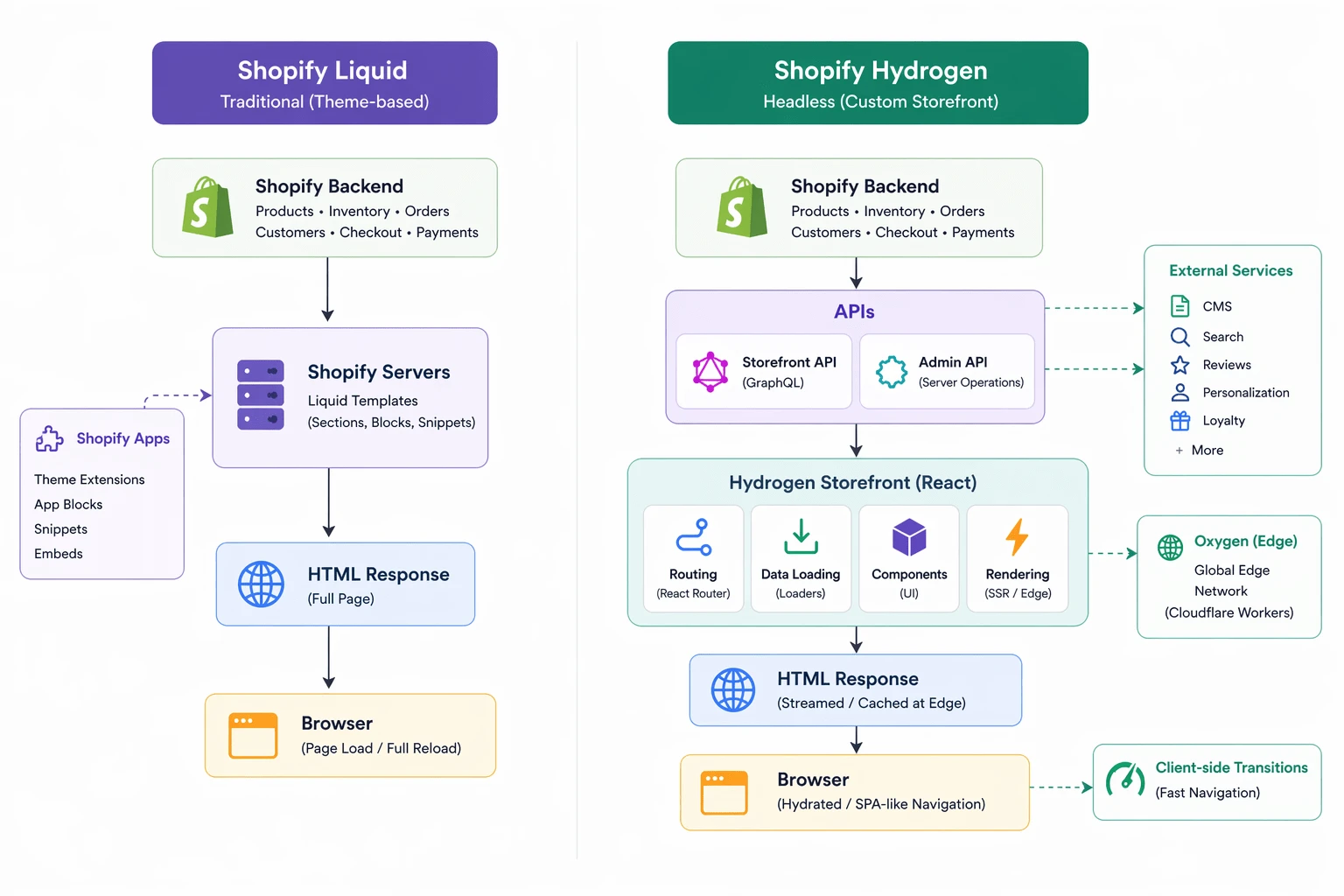
Liquid operates as a server-side templating layer. When a customer visits a page, Shopify's servers process the Liquid templates, inject the relevant store data such as products, collections, and cart details, and return fully rendered HTML to the browser. The architecture is straightforward: templates live in your theme, Shopify handles hosting and rendering, and the browser receives complete HTML on the first request.
A standard Liquid-based storefront is structured around sections, which are reusable layout components, blocks, which are configurable content units inside sections, and snippets, which are smaller reusable partials. Shopify's Online Store 2.0 expanded this with JSON templates and app blocks, giving merchants and developers more flexibility without touching core theme code.
Strengths of Liquid
- Low barrier to entry: Liquid syntax is readable and relatively simple. Junior developers and technically confident designers can work with it productively.
- Managed hosting: Shopify handles the infrastructure. There are no servers to provision, no CDN to configure, and no separate frontend deployment pipeline to maintain beyond theme deployment.
- App ecosystem compatibility: The vast majority of Shopify apps integrate through theme app extensions, Liquid, app blocks, or app embeds. A Liquid storefront fits naturally into this ecosystem.
- Fast time to market: Starting from a base theme and customizing it is dramatically faster than building a headless frontend from scratch.
- Battle-tested reliability: Liquid has been in production for years across millions of stores. Edge cases are well-documented and community knowledge is extensive.
Limitations of Liquid
- Performance ceiling: Liquid storefronts can be highly optimized, but page transitions still rely on standard document navigation rather than app-like client-side routing.
- Limited interactivity: Complex UI patterns, such as real-time product configurators, dynamic filtering without page reloads, or advanced multi-step flows, often require increasingly heavy JavaScript layered on top of the theme.
- Coupling to Shopify's rendering: You are constrained by what Shopify exposes in Liquid objects, tags, and filters. Pulling in data from third-party systems or composing content from multiple sources often requires workarounds.
- Section-based architecture limits: While sections and blocks are powerful for content editing, highly custom page designs can push theme architecture into structures that are harder to maintain over time.
What Is Shopify Hydrogen?
Shopify Hydrogen is Shopify's framework for building headless storefronts with React and the Storefront API. It gives developers full control over the frontend while keeping Shopify as the commerce backend for products, inventory, cart, checkout, and payments.
How Hydrogen Works
In a Hydrogen setup, the storefront is a separate application that communicates with Shopify through the Storefront API and, where needed for backend workflows, the Admin API. Hydrogen provides commerce-oriented tools and components for storefront development while giving teams more control over routing, rendering, data fetching, and caching than a standard theme architecture.
Hydrogen is commonly deployed on Oxygen, Shopify's edge hosting platform for headless storefronts. Oxygen is available at no additional cost on Shopify paid plans except Starter, and it is designed to deploy Hydrogen storefronts close to the user through Shopify's headless stack.
Hydrogen's Rendering Model
Hydrogen is not just a purely client-rendered single-page app. It supports server rendering, streaming, and client-side transitions, which allows teams to combine strong crawlability with more dynamic, app-like storefront experiences. The exact performance outcome depends heavily on implementation quality, bundle discipline, caching strategy, and third-party scripts.
Shopify Hydrogen Benefits
- Full frontend freedom: Any UI pattern, any design, and any interaction model is possible because you own the rendering layer.
- Composable commerce: Integrate third-party CMSs such as Contentful, Sanity, or Prismic, search providers such as Algolia or Constructor, and personalization or loyalty systems at the data layer instead of relying only on app embeds.
- Flexible performance architecture: Hydrogen supports edge delivery, streaming responses, and more advanced caching strategies, which can produce faster-feeling storefronts when implemented well.
- Independent deployments: The frontend and backend can evolve independently. A CMS switch, major redesign, or broader composable architecture does not require rebuilding your commerce backend.
- Component reuse: React's component model enables teams to build systems that scale across multiple storefronts, markets, or brands.
If you are evaluating Shopify Hydrogen development services, understanding these benefits in the context of your specific requirements is the critical first step before any technical scoping.
Shopify Hydrogen vs Liquid: Feature Comparison
| Dimension | Shopify Liquid | Shopify Hydrogen |
|---|---|---|
| Performance | Good. Server-rendered and highly optimizable, but standard navigation still follows theme-based page loads. | Potentially excellent. Supports edge delivery, streaming, and app-like transitions, but results depend heavily on implementation quality. |
| Customization | High within Shopify's theme constraints. Limited by available Liquid objects and theme structure. | Very high. Full control over HTML, CSS, JavaScript, rendering flow, and data-fetching architecture. |
| SEO | Strong out of the box. Server-rendered HTML, canonical URLs, and metadata are straightforward in themes. | Strong with proper implementation. Headless rendering can be fully crawlable, but technical SEO must be handled intentionally. |
| Development cost | Lower. Larger talent pool, faster onboarding, and reusable base themes. | Higher. Requires experienced React and headless commerce developers, plus deeper scoping upfront. |
| Hosting | Fully managed by Shopify. Included in all plans. | Oxygen on paid Shopify plans except Starter, or self-hosted on platforms such as Vercel, Fly.io, or Cloudflare. |
| Learning curve | Low to moderate. Liquid is approachable, and Shopify theme documentation is mature. | High. React, headless architecture, Storefront API workflows, and deployment practices all matter. |
| App ecosystem | Full compatibility. Most Shopify apps are designed to work naturally with themes and theme app extensions. | More limited. Many apps are built for theme injection and require custom integration or headless-friendly alternatives. |
| Checkout | Native Shopify checkout. Extensions via Checkout Extensibility. | Same native Shopify checkout. The headless storefront hands off to Shopify checkout. |
| Time to market | Fast. Custom theme builds can move quickly depending on scope. | Slower. A production-grade Hydrogen storefront usually requires more architecture and engineering time. |
| Maintenance | Lower. Shopify manages the infrastructure, and theme maintenance is relatively incremental. | Higher. You own the frontend application, dependencies, deployment process, and architectural upkeep. |
When Liquid Is the Right Choice
In the Shopify Hydrogen vs Liquid comparison, Liquid is not the "lesser" choice, it is the right choice for a significant majority of Shopify merchants. The following scenarios clearly favor a Liquid-based storefront.
Shopify Hydrogen vs Liquid
Standard Ecommerce with Established Patterns
If your storefront follows conventional ecommerce patterns, such as product listing pages, product detail pages, cart, and checkout, and your UX requirements can be met within those conventions, Liquid delivers everything you need with far less overhead. The pattern is well-understood, the tooling is mature, and the risk is low.
Budget-Conscious Projects
Hydrogen development requires senior React talent, longer timelines, and ongoing maintenance investment. For stores where the development budget is a meaningful constraint, the total cost of ownership difference between a polished Liquid theme and a custom Hydrogen build is significant, often several times higher for comparable scope.
Fast Launch Requirements
If your go-to-market timeline is measured in weeks rather than months, Liquid is the clear choice. A headless build requires architecture decisions, API integration design, and infrastructure setup before a single product page is rendered. Liquid development can proceed immediately from a theme scaffold.
App-Heavy Stores
Stores that rely heavily on third-party apps for subscriptions, reviews, loyalty programs, upsells, and product customization will usually find that the Shopify app ecosystem is built primarily for themes. Many apps do not offer the same level of headless readiness, and recreating their functionality in a Hydrogen frontend can erase much of the cost benefit of using apps in the first place.
When Hydrogen Makes Sense
On the other side of the Shopify Hydrogen vs Liquid debate, there are scenarios where Liquid's constraints become genuine blockers rather than minor inconveniences. These are the cases where investing in headless Shopify architecture pays for itself.
Custom UX and Advanced Interactivity
If your product experience requires real-time 3D configurators, animated room visualizers, complex multi-step purchase flows, or interaction patterns that feel more like a native application than a webpage, Liquid will usually fight you the whole way. Hydrogen gives you the flexibility of a modern component-based frontend to build these experiences more cleanly.
Multi-Channel and Multi-Storefront Architectures
Brands operating multiple storefronts, across regions, brands, or B2B and B2C channels, can benefit from a shared component library and a more centralized frontend architecture. A single design system used across multiple Hydrogen storefronts is often more maintainable than managing multiple independent Liquid themes.
Content-Heavy Brands
When editorial content is as important as the product catalog, think brands that operate closer to a media publisher model, the ability to pull content from a dedicated CMS such as Contentful or Sanity and commerce data from Shopify, then compose them in a unified frontend, becomes a material advantage. This content-commerce composition is where building a headless Shopify store creates the most differentiated experiences.
Performance as a Competitive Differentiator
For stores in highly competitive markets where conversion rate is closely tied to speed and user experience, especially mobile-first and high-traffic DTC brands, the additional engineering investment in Hydrogen can be justified by measurable business outcomes. The key point is not that Hydrogen is automatically faster, but that it gives teams more architectural tools to pursue performance aggressively.
Performance: Hydrogen vs Liquid in Real Numbers
Shopify Hydrogen vs Liquid performance comparisons are meaningful only when both implementations are well-optimized. A poorly built Hydrogen storefront can underperform a well-optimized Liquid theme. That said, the architectural ceiling of each approach is different.
Key Metrics
- Largest Contentful Paint (LCP): Both Liquid and Hydrogen can perform well when implemented correctly. Liquid benefits from Shopify's managed delivery model, while Hydrogen can benefit from edge delivery and more flexible rendering strategies. There is no universal benchmark that applies to every build.
- Interactivity: Liquid storefront interactivity depends heavily on theme architecture and front-end JavaScript decisions. Hydrogen can provide more app-like transitions and more controlled loading behavior, but only when the frontend is engineered carefully.
- Bundle size: Bundle weight varies widely in both approaches. Hydrogen can suffer from oversized frontend bundles if dependencies are not managed carefully, while Liquid storefronts can slow down significantly because of third-party app scripts and theme-level JavaScript choices.
- Navigation transitions: This is often the clearest difference. Liquid storefronts follow standard page navigation, while Hydrogen can support smoother client-side transitions that feel more immediate to the user.
Edge Rendering with Oxygen
Oxygen gives Hydrogen storefronts access to Shopify's edge hosting model, which can reduce latency and support advanced caching and rendering strategies. That said, edge deployment does not guarantee strong performance by itself. Results still depend on data-fetching patterns, cache strategy, JavaScript discipline, and third-party script control.
Migration Considerations: Moving from Liquid to Hydrogen
The Shopify Hydrogen vs Liquid migration from a Liquid storefront to Hydrogen is not a theme swap, it is a full frontend rebuild. Understanding what changes and what stays is essential for accurate planning.
What Changes
- The entire frontend: Every template, layout, component, and interaction must be rebuilt in React.
- Data fetching: Liquid's automatic access to Shopify objects is replaced by explicit GraphQL queries against the Storefront API.
- App integrations: Third-party apps must be re-evaluated for headless compatibility. Many will require custom integration or replacement with more headless-friendly alternatives.
- Hosting and deployment: You gain, and must manage, a separate deployment pipeline for the frontend application.
- Analytics and tracking: Event tracking, pixel implementations, and analytics setups may require rework, because some rely on theme-specific integration points.
What Stays
- The Shopify backend: Products, collections, inventory, orders, customers, and discounts remain exactly as they are. No data migration is required.
- Shopify Checkout: Hydrogen storefronts hand off to Shopify's native checkout. Your checkout experience, including Checkout Extensibility customizations, carries over.
- Shopify admin workflows: Merchants continue managing the store through the Shopify admin. The change is largely invisible to operations teams.
Cost and Timeline Expectations
A realistic migration from a moderately complex Liquid theme to a production-grade Hydrogen storefront should be scoped as a substantial engineering project, not a light redesign. For more complex stores with many app integrations, custom flows, or extensive content and search requirements, timelines and budgets increase quickly. Budget expectations should account for not only initial development but also ongoing frontend maintenance, dependency management, and the operational overhead of owning a separate frontend application.
Understanding the full scope of headless Shopify commerce development, from architecture decisions to ongoing operations, is important before committing to a migration roadmap.
The Hybrid Approach
A less-discussed Shopify Hydrogen vs Liquid option is the hybrid architecture: keeping your Liquid storefront for standard pages while deploying Hydrogen for specific high-value experiences.
How It Works
A common pattern is maintaining a Liquid-based storefront for the majority of pages, such as the homepage, collection pages, and standard product pages, while deploying a Hydrogen application for a specific interactive experience such as a custom configurator, a complex subscription flow, or a personalized landing page experience.
When the Hybrid Approach Makes Sense
- You have one or two specific experiences that require React-level interactivity but do not want to rebuild the entire storefront.
- You want to pilot Hydrogen at limited scope before committing to a full migration.
- Your team has mixed skills, with Liquid specialists for standard pages and React developers for the experiences that need more flexibility.
Limitations to Acknowledge
The hybrid approach introduces routing complexity and potential UX inconsistencies at the boundary between the two frontends. Performance characteristics can differ between sections of the site, and maintaining two separate codebases creates its own overhead. It is a useful intermediate strategy, but usually not the cleanest permanent architecture for most teams.
Conclusion
The Shopify Hydrogen vs Liquid decision ultimately comes down to what your storefront needs to do, what your team is capable of building and maintaining, and what your timeline and budget allow.
Choose Liquid if: you need to move fast, your technical requirements fit within standard ecommerce conventions, your team is not fluent in modern frontend architecture, or your store depends heavily on the Shopify app ecosystem. Liquid is not a compromise, it is the right architectural choice for the majority of Shopify stores.
Choose Hydrogen if: your storefront requires custom interactivity that Liquid cannot support cleanly, you are building a multi-brand or multi-channel architecture, performance at scale is a measurable business priority, or you need to compose commerce data with content from external systems. The investment is real, but so are the capabilities it unlocks.
The most important thing to avoid is choosing Hydrogen because it is newer or because it signals technical sophistication. The right architecture is the one that solves your actual problems within your actual constraints. When evaluating Shopify Hydrogen vs Liquid, start with a clear problem statement, assess your team's capabilities honestly, and let those inputs drive the decision, not the other way around.
If you are working through this decision and need experienced guidance on scoping a Hydrogen build, evaluating whether migration makes sense for your store, or architecting a hybrid approach, our team at MGroup specializes in exactly this kind of technical planning and execution for Shopify merchants at scale.