

General Overview: Etsy vs eBay
The choice between online marketplaces depends on understanding how each platform differs from the others. Etsy vs eBay give sellers different chances to succeed. Each platform comes with its own business model, target audience, and selling environment. Let's get into what makes them unique.
What is Etsy?
Etsy leads the global marketplace for creative and unique goods. The platform connects 8 million sellers with 96 million active buyers worldwide. The company started a mission to keep human connection central to commerce. Sellers can list handmade items, vintage goods (at least 20 years old), and craft supplies. The platform works great as both a creative outlet and business venture. About 95% of Etsy sellers work from home, and 54% call Etsy their main sales channel even though they sell on other platforms too.
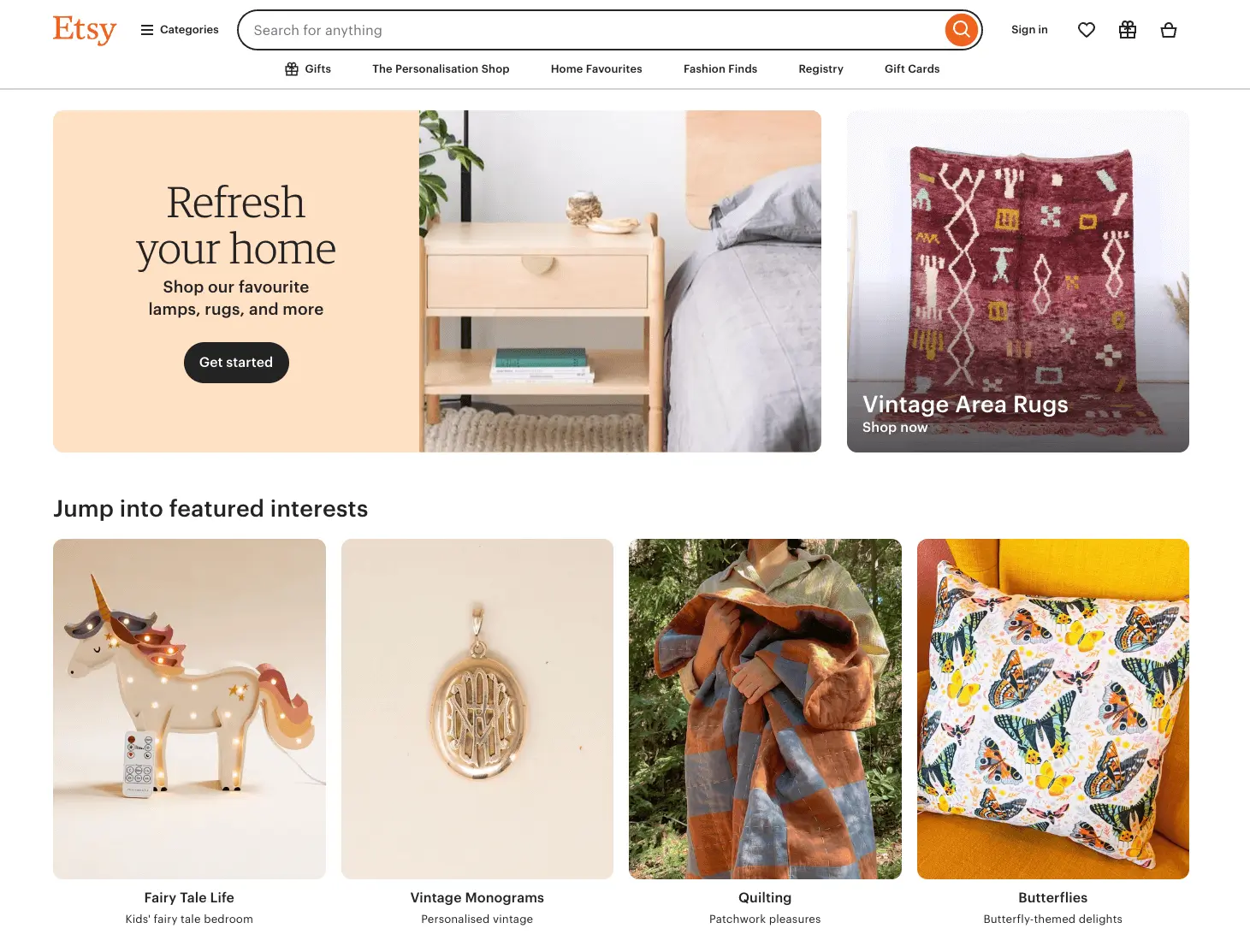
Etsy's specialized community makes it stand out. Around 83% of buyers say they find items on Etsy they can't get anywhere else. The platform gets 80% of its traffic from direct or organic sources. This helps sellers use Etsy's reputation instead of spending big on ads. Creative people who want to make money from their skills will find a thriving community here. Artists, designers, and crafters share their passion for unique goods on the platform.
What is eBay?
Pierre Omidyar created eBay in September 1995. The platform has grown into a multinational e-commerce giant that serves 190 markets worldwide. eBay works differently from Etsy's focused approach. Users can buy or sell almost anything legal through auctions or fixed-price ("Buy It Now") formats. The numbers tell the story - 133 million active buyers, roughly 18 million sellers, and almost two billion live listings globally.
The platform's reach spans continents with 31% of sellers based in the US and 29% in the UK. eBay processed $73 billion in transactions during 2023, with 48% coming from the US. The platform's reputation system lets buyers and sellers rate each other after transactions. Sellers get access to useful tools like the global shipping program. Software developers can integrate through eBay's API. The platform started as an auction site but now serves as a reliable marketplace. Both casual and professional sellers can thrive here.
Key Differences Between Etsy and eBay
Let's head over to the marketplace battle between Etsy vs eBay to see key differences that affect seller success. These platforms give sellers unique advantages. Understanding what sets them apart helps you pick the right platform for your business goals.
The customer base differs by a lot between platforms. Etsy connects with about 92 million active buyers (60% US, 40% international) who care more about product uniqueness than price. eBay reaches 133 million active buyers (51% US, 49% international). eBay's audience is mostly male (59%) between ages 25-34.
The product focus sets clear boundaries. Etsy only allows handmade, designed, or vintage items that you create or source yourself. eBay gives you more room to work with—you can sell almost anything from homemade goods to used household items.
Each platform's sales models work differently. Etsy sticks to a fixed-price model and processes payments through Etsy Payments. eBay lets you choose between auctions and fixed "Buy It Now" pricing—or you can mix both options.
The fees and pricing show notable differences:
| Feature | Etsy | eBay |
|---|---|---|
| Listing Fee | 20¢ per item (renews every 4 months) | 250 free listings monthly, then 35¢ each |
| Transaction Fee | 6.5% of total sale (including shipping) | 13.25% for most categories |
| Additional Fees | Payment processing: 3% + 25¢ per transaction (US) | Per-order fee: 30¢-40¢ |
| Premium Options | Etsy Plus: $10/month | Store subscriptions: $4.95-$2999.95/month |
Choose Etsy if: You make handmade, unique, or vintage items and want a simple selling process with buyers who love creative products.
Choose eBay if: You sell many types of items (new or used), want to try auctions, or need to reach more buyers in different product categories.
What Products Do They Sell?
Each marketplace's identity and seller opportunities depend on what products you can sell on Etsy vs eBay. You should know the selling options on both platforms before starting your online business.
Product Categories on eBay
eBay gives sellers amazing flexibility to list almost anything that's legal - from new electronics to used household items. Recent eBay data shows that new products make up 80% of listings, while used items account for 20%. The platform groups its listings into several major categories:
- Electronics: Computers, tablets, cell phones, cameras
- Clothing & Accessories: Women's, men's, handbags, collectible sneakers
- Motors: Parts, cars, motorcycles, other vehicles
- Collectibles & Art: Trading cards, coins, sports memorabilia
- Home & Garden: Yard equipment, tools, kitchen supplies
- Business & Industrial: Heavy equipment, restaurant supplies
eBay's rules ban the sale of counterfeit items, stolen goods, weapons, drugs, hazardous materials, and anything that violates intellectual property rights.
Product Categories on Etsy
Etsy follows strict guidelines that allow only handmade, designed, or directly sourced items. The platform serves as a creative marketplace with these categories:
- Jewelry: This category tops the sales charts consistently
- Clothing: T-shirts, hoodies, vintage dresses
- Home & Living: Wall art, home decor, furniture
- Craft Supplies & Tools: Beads, fabric, yarn
- Art & Collectibles: Prints, sculptures, photography
- Bath & Beauty: Handmade soaps, cosmetics
The platform considers items "vintage" when they're at least 20 years old. Sellers can't use dropshipping or reselling methods, and Etsy prohibits alcohol, tobacco, weapons, hate items, and recalled products.
Selling on Etsy vs eBay: Which Platform Is Better for Your Business?
Your business needs the right marketplace that lines up with your selling goals. Let's get into the selling experience on both platforms to help you make the best choice.
Selling on eBay
eBay gives sellers access to 134 million active buyers worldwide. The platform's users are 59% male, with most falling in the 25-34 age group. Note that eBay stands out with its auction feature, though you can use "Buy It Now" for instant sales.
Selling on eBay Pros:
- Reaches buyers in 190 markets worldwide
- You can sell almost anything legal
- Keeps 83% of customers coming back
- Safe transactions with seller protection
Selling on eBay Cons:
- Fees run high (13.25% for most items plus per-order charges)
- Rules are strict with limited policy flexibility
- Popular categories face tough competition
- Managing inventory gets tricky across multiple platforms
Selling on Etsy
Etsy links sellers with 92 million active buyers looking for unique, handcrafted items. About 95% of Etsy sellers work from home, and 54% call it their main sales channel even when selling on other platforms.
Selling on Etsy Pros:
- Quick and easy setup without tech expertise
- Better fees (6.5% per transaction compared to eBay's 13.25%)
- 80% of shoppers come directly or through organic search
- Trusted payment system builds buyer confidence
Selling on Etsy Cons:
- Only sells handmade, vintage, or craft supplies
- Hard to build your brand beyond Etsy's marketplace
- More sellers join the platform each day
- Platform restricts store customization options
Choose selling on eBay if: You need a bigger market for various products, want auction options, or seek a diverse buyer base.
Choose selling on Etsy if: You make handcrafted items, want creative buyers, or prefer lower fees.
Restricted Products on Etsy and eBay
Knowing what you can't sell matters just as much as knowing what you can sell when you compare Etsy vs eBay. Both platforms have strict policies to protect everyone involved and follow legal regulations. Their prohibited items are substantially different because they have different business models.
Products You Can't Sell on eBay
eBay bans many items to keep its marketplace safe and follow the law. Here are the most important things you can't sell:
- Fake merchandise and copies of brand-name items
- Firearms, ammunition, and anything weapon-related
- Alcohol and tobacco products (with very few exceptions)
- Adult content and pornographic materials
- Drugs and drug paraphernalia
- Recalled products and hazardous materials
- Items that violate intellectual property rights
Products You Can't Sell on Etsy
Etsy's banned items list matches its focus on handmade, vintage, and craft supplies. So, you can't sell:
- Mass-produced or factory-made items
- Resold commercial products (dropshipping)
- Products that promote hate or glorify violence
- Weapons and dangerous materials
- Alcohol, tobacco, drugs and related items
- Animal products from endangered species
- Recalled products and hazardous materials
Choose eBay if: You want to sell commercially manufactured goods, whatever their origin.
Choose Etsy if: You create handmade items, sell vintage goods, or offer craft supplies that match their creative marketplace rules.
Etsy and eBay Fees & Shipping
The cost structure and shipping capabilities of each platform are essential factors when comparing marketplaces. Etsy and eBay use different fee systems and shipping tools that substantially affect your earnings as a seller.
Etsy Fees
Etsy keeps its fee structure simple yet complete:
- Listing fee: 20¢ per item that renews every four months
- Transaction Etsy fees: 6.5% of the total sale price including shipping
- Payment processing fee: 3% plus 25¢ per transaction in the US
- Subscription (optional): $10 monthly for Etsy Plus with additional features
- One-time set-up fee: Non-refundable shop setup fee (varies by location)
- Currency conversion: 2.5% fee if your customer uses a currency different from USD
eBay Fees
eBay's fee structure changes based on seller volume:
- Insertion fee: 250 free listings per month, then 35¢ per additional listing
- Final value fee: 13.25% on completed sales for most categories
- Per-order fee: 30¢ to 40¢ depending on order value
- Store subscriptions: Range from $4.95 (Starter) to $2,999.95 (Enterprise) monthly
Etsy Shipping Options
Etsy makes shipping simple for sellers:
- Discounted postage labels through USPS, FedEx, and Canada Post
- Built-in Etsy shipping profiles to save and reuse shipping settings
- Easy calculation of shipping cost rates
- Assistance with customs forms for international shipping
eBay Shipping & Global Shipping Program
eBay shipping solutions are very flexible:
- Shipping calculator to estimate costs accurately
- Printable shipping labels from home
- Free co-branded shipping supplies
- Global Shipping Program: ship to a US hub where eBay handles international customs and delivery
- Protection against item not received claims once accepted at the domestic hub
- Available to sellers in 100+ countries worldwide
Choose Etsy if: Lower overall fees and simpler shipping management match your needs. Choose eBay if: Free listings and hassle-free international shipping support are your priorities.
Who Should Sell on Etsy?
Etsy stands out as a vibrant marketplace for entrepreneurs with specific niches. The numbers tell an interesting story - 97% of Etsy sellers work from their homes, and 25% live in rural areas. This makes the platform perfect to start a business from anywhere.
Creative minds and skilled artisans thrive best on this platform. Etsy's rules are clear - you can only sell things "you've made, designed, handpicked, or directly sourced". The platform now connects 7 million active sellers with 92 million active buyers worldwide, which opens up amazing opportunities for the right businesses.
Money-wise, a typical Etsy seller earns around $44,000 per year. Smart sellers who study market trends and find their sweet spot can reach $500,000 in sales. This big gap shows why research and positioning matter so much.
Etsy works great for:
- Creative entrepreneurs, artists, and content makers
- People starting businesses from home with small budgets
- Anyone selling unique, handmade, or vintage items
- Sellers who want to reach a huge customer base (81.9 million buyers)
Etsy might be right for you if:
- You make handmade or designed items, or sell vintage goods
- You want to work from home without complex tech setup
- You need a place where 83% of buyers find unique items they can't get elsewhere
- You prefer a platform that gets most of its traffic (80%) organically
Advertising on Etsy vs eBay
Marketplace giants Etsy and eBay provide advertising solutions to boost visibility and sales. Their approaches differ in cost structure and targeting capabilities.
Etsy Ads
Etsy's advertising platform uses a pay-per-click (PPC) model where sellers pay only when buyers click their ads. The system lets you:
- Set a daily budget (minimum $1.00) that stays within limits
- Get visibility in Etsy's search results, category pages, and mobile app
- Allow Etsy Ads algorithm to place listings for optimal performance
Your listing's tags, titles, and attributes play a significant role in matching products with potential buyers. Etsy's system automatically sets bid amounts based on expected sales from ad clicks.
eBay Ads Promoted Listings, Store Subscriptions
eBay gives sellers two main advertising options:
- Promoted Listings Standard: Sellers pay after an ad click leads to a sale (cost-per-sale model)
- Promoted Listings Advanced: Sellers pay per click and get priority placement (cost-per-click model)
eBay's store subscribers get extra promotional tools like the Promotions Manager to run sales events. The platform's Promoted Stores feature shows attractive ads that send buyers straight to your store.
Choose Etsy if: You want a simple PPC model that optimizes automatically. Choose eBay if: You need flexible payment options (pay-per-sale or pay-per-click) with advanced targeting controls.
Is Etsy or eBay Better?
Let's dive into both marketplaces and find out which platform works best for your business.
Your business model and products will determine the right choice. Etsy stands out as the perfect platform if you sell handmade, vintage, and creative goods. Buyers come to Etsy looking for unique items, not just the cheapest deals. The platform also keeps things simple with transaction fees at 6.5%, while eBay charges 13.25%.
eBay, a 25-year-old marketplace giant, welcomes sellers of new and used products in almost any category. With 133 million active buyers compared to Etsy's 92 million, eBay gives you access to a bigger market and higher sales potential.
Etsy makes the most sense for content creators, artists, and creative product sellers. You don't need advanced technical skills to use its user-friendly platform - just great products and the right audience targeting.
eBay tends to work better for retailers, wholesalers, and professional or second-hand sellers. Sellers get more control over their listing design, shipping rates, and return policies.
Mgroup's team of Shopify experts can help your online business thrive. We customize our services from marketing to web design based on what you need. Reach out today and let us help you succeed.
Conclusion
Your choice between Etsy vs eBay ended up coming down to your business model, products, and long-term goals. Without doubt, both platforms are a great way to get started in e-commerce, each with its own strengths for different types of sellers.
Our comparison shows that Etsy works best as a specialized marketplace for creative entrepreneurs who sell handmade, vintage, or craft supply items. eBay, on the other hand, lets you sell almost anything legal through both auction and fixed-price formats. The fees are quite different too - Etsy fees a straightforward 6.5% transaction fee, while eBay fees takes a higher 13.25% for most categories.
eBay Shipping Global Program makes it easier for international sellers. Etsy helps you manage shipping with discounted postage labels. On top of that, each platform draws different types of buyers - Etsy attracts shoppers looking for unique, creative products, while eBay brings in a broader audience interested in everything from collectibles to everyday items.
Here are some clear guidelines to help you decide:
Pick Etsy if you:
- Make handmade items, vintage goods, or craft supplies
- Want lower transaction fees and simpler fee structures
- Run your business from home with minimal startup money
- Need to reach buyers who want unique products
- Prefer organic traffic over paid ads
Go with eBay if you:
- Sell different types of new or used products
- Need both auction and fixed-price listings
- Want to reach a bigger global market
- Need strong international shipping support
- Plan to resell commercial products
Note that you'll succeed on either platform if you know your target audience, optimize your listings, and give great customer service. The "better" platform isn't the same for everyone - it's the one that matches your selling style and business goals best.
Why Every Brand Still Needs a Shopify Store
Successful online businesses know that having their own independent Shopify store matters just as much as choosing between Etsy vs eBay. A standalone Shopify presence is a chance to gain advantages that marketplaces cannot match, even when marketplace sales work well.
Shopify gives you complete control over your brand's experience. You can customize everything from store design to checkout process with more than 70 no-code themes. Your unique brand identity shines through naturally, unlike the restricted marketplace formats.
The customer relationship dynamics change with Shopify. Marketplace customers stay loyal to the platform instead of individual sellers. However, Shopify lets you own your customer data and create stronger connections through its built-in marketing tools.
The financial benefits are clear. Shopify's fees are lower than both Etsy and eBay. You pay no transaction fees when using Shopify Payments. This structure helps your profits grow as your business scales.
Smart sellers maintain both marketplace presence and a Shopify store. Research shows businesses with multiple sales channels see 38% higher average order values. They also experience a 20% increase in sales across both platforms.
Shopify Development Agency Mgroup, as Shopify Partners, brings together experts who help online businesses grow. We provide marketing and custom web design services that match your business needs. Reach out today to discover how we can help you succeed.
FAQ: Etsy vs eBay: Which Platform Is Best
Is it better to sell on Etsy or eBay?
Etsy is better for handmade, vintage, and niche products, while eBay is ideal for resellers, auctions, and reaching a global audience. The right choice depends on your product type and target customers.
What sells better on Etsy?
Etsy is best for handmade products, custom items, craft supplies, vintage goods (20+ years old), and unique designs. Sellers with strong branding and storytelling usually perform well.
What sells better on eBay?
eBay works best for electronics, refurbished goods, collectibles, fashion, and mass-market products. It also attracts buyers looking for deals through auctions.
Which platform has lower fees — Etsy or eBay?
Etsy charges listing fees and transaction fees, while eBay uses insertion fees and final value fees. Depending on your sales volume and product category, one may be cheaper — but eBay often has a slight advantage for high-volume sellers.
Does Etsy have higher shipping costs than eBay?
Etsy shipping costs depend on seller settings and carrier choice. eBay offers discounted rates through its Global Shipping Program, which often makes it cheaper for international orders.
Can I sell the same products on both Etsy and eBay?
Yes, many sellers list on both platforms. Etsy is great for brand identity and niche buyers, while eBay expands reach to international and auction-driven audiences.
How does advertising work on Etsy vs eBay?
Etsy offers Etsy Ads and Offsite Ads, while eBay provides Promoted Listings and Store Subscriptions. Both platforms help boost visibility, but eBay’s tools are more advanced for scaling larger businesses.
Who should choose Etsy over eBay?
Choose Etsy if you sell handmade, creative, or vintage items and want to build a brand story. Choose eBay if you sell mass-market, used, or collectible products and need global reach.