

For a decade the job was to rank on a page of blue links. That job has not disappeared, but a second one has arrived beside it: being readable by software that shops on a customer’s behalf. Agentic commerce Shopify work is the practical answer to that — making sure an assistant can find your products, trust your availability, quote your policies correctly, and complete a purchase without a person ever opening your storefront.
This guide covers what actually changes for merchants: how AI agents read a catalogue, which protocols matter and what each one does, what Shopify already exposes without you lifting a finger, and the handful of data problems that decide whether your products appear in an answer or get skipped.
What agentic commerce means for a Shopify store
Agentic commerce is shopping mediated by an AI agent. A customer describes what they want in ChatGPT, Gemini, Copilot or Google’s AI Mode; the assistant searches across merchants, compares options, and increasingly can put items in a cart and complete checkout. The merchant is still the seller of record — but the shop window has moved.
The important shift is not visual. It is that your catalogue is now consumed twice: once by a human reading a product page, and once by software calling a structured endpoint. Those two consumers have very different tolerances. A shopper forgives an out-of-date size chart. An agent that reads stale availability will confidently sell something you cannot ship, or skip your product entirely because it cannot verify the claim.
That is the whole discipline in one sentence: agentic commerce Shopify readiness is data hygiene with a new consumer and much lower tolerance for ambiguity.
How AI agents read your catalogue
Agents do not scrape your theme. They call structured endpoints. On Shopify the main one is the Storefront MCP server, built on the Model Context Protocol — an open standard for handing structured context to AI models.
Shopify exposes it at /api/mcp, with the UCP catalogue served from a separate /api/ucp/mcp endpoint. The calls need no authentication, though access can be restricted per store. What an agent actually invokes are named tools:
- search_catalog — natural-language product discovery across your catalogue
- lookup_catalog and get_product — resolving a specific item and its attributes
- get_cart and update_cart — building and modifying a cart
- search_shop_policies_and_faqs — reading your shipping, returns and warranty terms
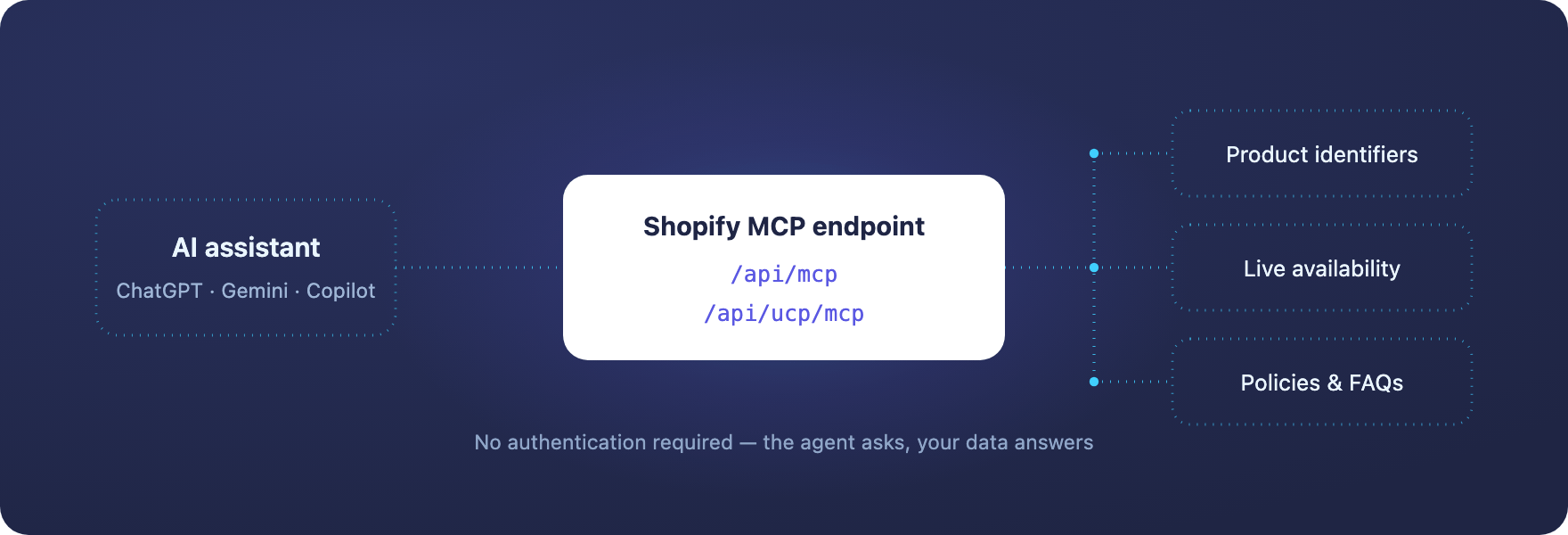
Notice what is missing from that list: your hero banner, your brand story, your carefully art-directed lookbook. None of it reaches the agent. What reaches the agent is structured data — which is why merchants with beautiful stores and messy product records lose to plainer competitors with clean records.
There is a second server worth knowing about. Where the storefront endpoint handles catalogue, cart and policy questions, a customer account endpoint covers order status, returns and account information — the post-purchase half of the conversation. Most merchants meet the storefront side first, because that is where discovery happens, but “where is my order” is one of the highest-volume questions any assistant will ever be asked about your brand.
What agents can already do — and what they still cannot
It helps to be precise here, because the gap between demo and reality is where budgets get wasted.
Agents can already search a catalogue in natural language, resolve a specific variant, read live pricing and availability, build a cart, and quote your published policies. On surfaces with a checkout integration they can complete a purchase, with the merchant remaining seller of record and payment credentials never exposed to the agent.
What they still cannot do reliably is infer facts you have not stated. An agent will not deduce that a jacket is waterproof from a photograph, will not guess whether your 30-day return window starts at dispatch or delivery, and will not resolve a contradiction between your product page and your FAQ. Faced with uncertainty it does the same thing a cautious shop assistant does: it recommends the option it can describe with confidence. That is usually a competitor.

Clean record versus ambiguous record
The difference is easier to see than to describe. Two merchants sell the same laptop backpack:
| Data point | Ambiguous record | Record an agent can use |
|---|---|---|
| Identifier | SKU “BP-BLK-2” only | GTIN + MPN + consistent SKU per variant |
| Capacity | “Roomy enough for daily carry” | Metafield: 22 L |
| Laptop fit | Mentioned in a description paragraph | Metafield: fits up to 15.6″ |
| Water resistance | Implied by product photography | Metafield: IPX4, tested |
| Availability | Synced nightly | Live, per location |
| Returns | “Flexible returns policy” | 30 days from delivery, free within the EU |
Ask an assistant for “a waterproof backpack under 25 litres that fits a 15-inch laptop, returnable if it doesn’t fit” and only one of those two merchants can be recommended. Neither store had to be redesigned. One simply answered the question in fields instead of adjectives.
Do you need Shopify Plus for this?
No. The storefront endpoint and the structured product data behind it are not a Plus-tier feature, and the four data problems above are solved in the same places on every plan: product records, metafields, inventory settings and policy pages.
Plus becomes relevant for adjacent reasons — checkout extensibility, B2B, scripting and multi-market complexity — not as a gate on agent readiness. If someone is selling you an upgrade primarily to be visible to AI assistants, ask which specific capability you are buying.
MCP, UCP and ACP: three names, three jobs
The protocol landscape looks more crowded than it is, because the three names people repeat are doing different jobs rather than competing head-on.
MCP — the transport
The Model Context Protocol standardises how an application hands structured context to an AI model. It is the pipe. Shopify’s storefront and catalogue endpoints are MCP servers, which is why “does Shopify support MCP” has a short answer: yes, and it is already running.
UCP — discovery and checkout
The Universal Commerce Protocol covers both halves of the transaction: letting agents discover products across merchants and letting them complete a purchase. Merchants host their own product data, and any agent can read it. Shopify serves the UCP catalogue from its own endpoint alongside the standard storefront tools.
ACP — the checkout handshake
The Agentic Commerce Protocol, built by Stripe and OpenAI and released as open source under Apache 2.0, is narrower and deeper: a specification for making checkout agent-ready, including secure transfer of payment tokens without exposing the underlying credentials. It supports physical goods, digital products and subscriptions, and works over both REST and MCP. Its own documentation is candid that merchant discovery mechanisms are still in development — ACP is a checkout standard first.
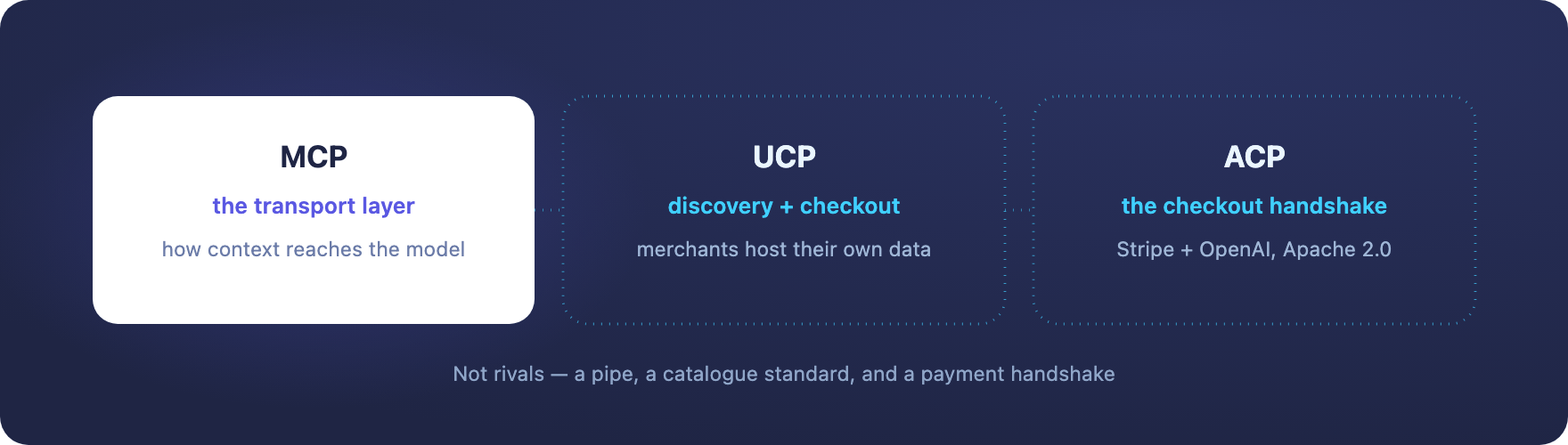
The practical takeaway for merchants is unglamorous: protocol politics will keep moving, and almost none of the work you should do this quarter depends on the outcome. Identifiers, availability accuracy and quotable policies pay off under every one of them.
What Shopify already gives you
A useful amount of this is switched on without a project. The storefront MCP endpoint exists on eligible stores, the tool set above is standard, and structured product data flows from your existing product records. You do not implement MCP. Agentic commerce Shopify work is the discipline behind it, not the switch.
That is worth stating plainly, because a lot of the agency pitching around agentic commerce Shopify readiness implies a large integration that in most cases is not the constraint. The constraint is the quality of what the endpoint returns.
What decides whether your product appears in the answer
Four data problems account for most of the misses we see in agentic commerce Shopify audits.
Ambiguous identifiers. If your variants lack GTINs, MPNs or consistent SKUs, an agent cannot confidently match your product to the one the shopper described, or reconcile it with the same product on another surface. Ambiguity is resolved by skipping you.
Availability that is not really live. Inventory that syncs on a schedule rather than in real time produces the worst possible outcome — an agent that promises a delivery date you cannot meet. Multi-location inventory makes this harder, not easier, and it is worth auditing separately.
Attributes buried in prose. Material, dimensions, compatibility and care instructions written only inside a description paragraph are far weaker than the same facts as structured metafields. If a shopper asks for “waterproof, under 2 kg, fits a 15-inch laptop”, those have to be fields, not sentences.
Policies an agent cannot quote. search_shop_policies_and_faqs exists precisely because assistants need to answer “can I return this?” before recommending you. Vague or contradictory policy pages produce hedged answers, and hedged answers lose to specific ones.
Five mistakes we see in agentic commerce Shopify audits
Across audits the same failures repeat, and none of them are exotic.
- Variant-level data that only exists at product level. Colour, size and fit are stated once in the description and never on the variant. An agent asked for a specific size cannot confirm it exists, so it recommends a store that can.
- Policy pages that contradict the FAQ. One says 30 days, the other says 14. An assistant that finds both will either hedge or quote the wrong one back to your customer, and you will hear about it after the sale.
- Shipping promises with no geography. “Fast free delivery” is unusable. “Free delivery within the EU, 2–4 working days” can be quoted, compared and won on.
- Discontinued products left published. Legacy SKUs kept live for their backlinks are read as available inventory. Every one of them is a chance to be recommended for something you cannot ship.
- Blocking crawlers by accident. A robots rule added for a staging site, an aggressive firewall rule, or a bot-protection setting turned to maximum — all of them quietly remove you from consideration, and none of them show up in your analytics.
The reason these persist is that none of them break the storefront. A human shopper never notices any of the five. That is exactly why agentic commerce Shopify audits find them and ordinary QA does not.
Policies, returns and shipping are now product features
This is the change merchants underestimate most. When a human compares two stores, policy is a footnote read after the decision. When an agent compares them, policy is a field weighed during the decision — and it will be quoted back to the customer as fact.
Write policies in short, declarative sentences with concrete numbers. “Returns accepted within 30 days of delivery, unworn, with original packaging; return shipping is free within the EU” is quotable. “We aim to be flexible with returns wherever possible” is not, and an assistant will either skip it or paraphrase it into something you did not promise.
Measuring whether any of this works
Agent traffic is easy to lose in analytics because it does not behave like a session. Referrals arrive without the usual pattern, some agents complete a purchase without a storefront visit at all, and default reporting quietly buckets them as direct.
Separate agent traffic from human traffic before you invest heavily, or you will have no way to tell whether the work paid. That means recognising known agent user-agents, keeping the segmentation out of your primary conversion reporting, and being honest that attribution here is still immature — measure the trend, not the decimal place.
In practice three numbers are worth watching from the start of any agentic commerce Shopify programme. The first is the share of sessions arriving from known assistant surfaces, tracked as a trend line rather than a target. The second is how often your policy and availability data is queried, which tells you whether agents are getting far enough to evaluate you at all. The third is the gap between assisted discovery and completed orders — a wide gap usually means an agent could describe your product but could not confirm something it needed, and that points straight back at the data.
None of these will be precise for a while. The point is not precision. The point is having a baseline before you change anything, so the next conversation about budget is evidence rather than opinion.
Should you block AI crawlers instead?
Some merchants’ first instinct is to close the door. It is a defensible position for a brand whose margin depends entirely on owned traffic, and a poor one for almost everybody else — blocking removes you from consideration rather than protecting you within it.
The middle path is the sensible one: allow the crawlers and agents that drive commercial discovery, expose the catalogue and policy data they need, and keep genuinely sensitive surfaces — customer accounts, internal search logs, unlaunched collections — out of scope. That is a robots and access-control decision, not an all-or-nothing switch.
Agentic commerce Shopify readiness: a practical order of work
If you do nothing else, do these in this order:
- Fix identifiers. GTIN, MPN and SKU consistency across every variant. Unglamorous, highest return.
- Make availability real. Move inventory sync from scheduled to live, and audit multi-location logic.
- Move attributes into metafields. Anything a shopper might filter on belongs in a field, not a paragraph.
- Rewrite policies to be quotable. Numbers, timeframes, and no hedging.
- Instrument agent traffic separately so the next decision is made on evidence.
- Then look at protocol-specific work, once the data underneath is worth exposing.
Steps one to four are ordinary catalogue hygiene that also improves your conventional SEO, your feed quality and your on-site filtering. That is the honest reason to start now: the work pays for itself even if every prediction about agentic commerce turns out to be early.
Where this goes next
The direction of travel is clear even though the details are not. Discovery is consolidating around structured, merchant-hosted catalogue data; checkout is consolidating around tokenised handshakes that keep the merchant as seller of record; and the surfaces doing the asking will keep multiplying.
Merchants who treat agentic commerce Shopify work as a channel to be gamed will chase each protocol announcement. Merchants who treat agentic commerce Shopify readiness as a data quality problem will be ready for all of them, which is the whole argument for starting with the boring parts.
If you want a second pair of eyes on what your store currently returns, our agentic commerce readiness service starts with exactly that audit. It pairs well with our guides on ChatGPT Shopping and AI commerce and on Shopify GEO optimisation, which cover the discovery side in more depth.